You’ll need to apply for this course through your employer, with their support. Individuals cannot apply directly to the University.
Overview
If you’re already working in healthcare and want to take the next step, this course offers the perfect opportunity to become a qualified, registered nurse. Designed to fit around your current role, you’ll benefit from a balanced mix of theory and hands-on practice, giving you the confidence to deliver exceptional care in a variety of healthcare settings.
Throughout the programme, you’ll learn essential nursing techniques and approaches for supporting people of all ages and backgrounds. In your final year, you’ll also develop leadership skills and gain a deeper understanding of how to work effectively with different healthcare teams across the health service.
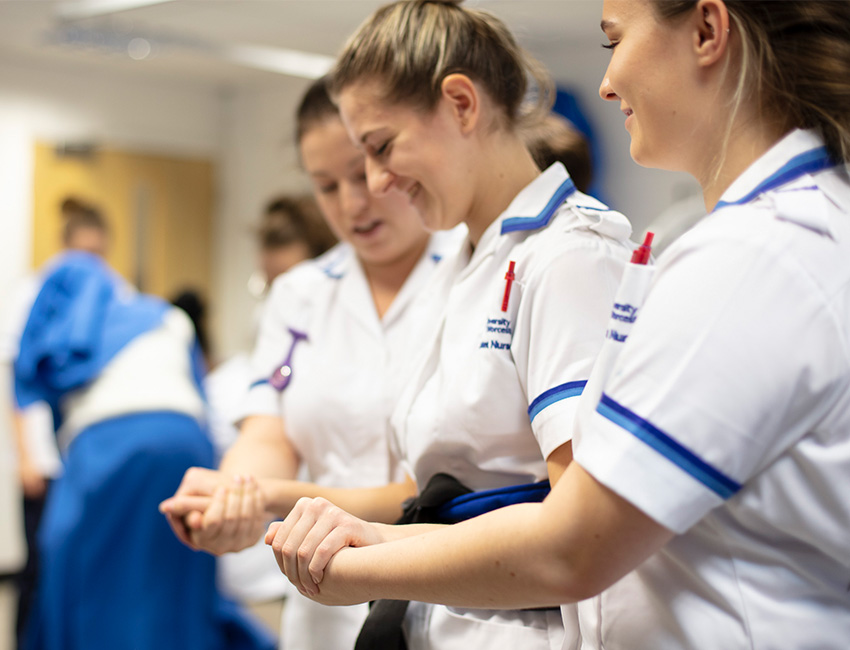
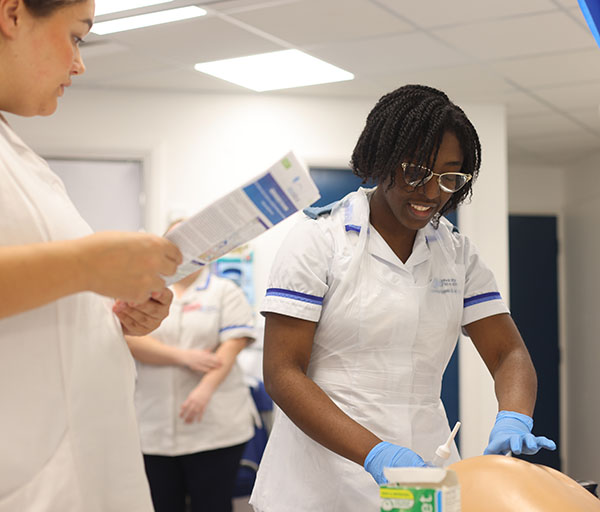
Every module is carefully structured to meet the Nursing and Midwifery Council (NMC) standards, ensuring you graduate with the knowledge and qualities expected of a Registered Nurse. Through placements and hands-on sessions in our Skills and Simulation Centre, you’ll gain confidence in making clinical decisions, assessing risks, planning care, and communicating with patients and colleagues. All of this takes place in a safe, supportive environment designed to help you learn and grow.
How apprentices study
Teaching and learning on an apprenticeship will be a collaborative process between you, your employer and the university. This will include attending university for tutorials, work-based learning, when required to complete the apprenticeship an alternative placement and mentoring by a qualified/experienced colleague.
Typically, class contact time per day will be structured around:
- 2 hours lead lecture
- 4 hours of seminar, workshop or tutorials
While on placement you will attend placement for 37.5 hours per week (full-time route), or 28-29 hours per week (part-time route) experiencing the full range of hours expected of a Registered Nurse.
Nursing in 60 seconds
Course content
Your work-based learning will be supported by a mix of seminars focusing on theory and simulations so you can apply what you’ve learnt in a safe and controlled environment. Our modules are designed to provide you with the required skills outlined by both Skills England and the NMC.
We regularly review our courses to reflect the latest research and developments in the subject area, as well as feedback from students, employers and the wider sector. As a result, modules may change to ensure the course remains current and relevant.
Careers and employability
Once you’ve completed this course, you’ll be eligible to register with the Nursing and Midwifery Council and begin a rewarding career in either adult nursing or mental health nursing. This qualification can support your progression within your current workplace.
You’ll also open up opportunities to work across a wide range of healthcare settings, including:
- NHS and private hospitals
- Adult social care settings
- Mental health, learning disability and postural care services
- Community services and care delivered in people’s homes
Most graduate apprentices are offered roles within their workplace as Registered Nurses. As your career develops, you may progress into roles such as:
- Senior staff nurse
- Clinical nurse specialist
- Advanced clinical practitioner
- Ward or service manager
- Practice educator
- Research or quality improvement roles
Your apprenticeship provides a strong foundation for long‑term professional growth, enabling you to build a meaningful career in nursing.
Course highlights

Teaching and assessment
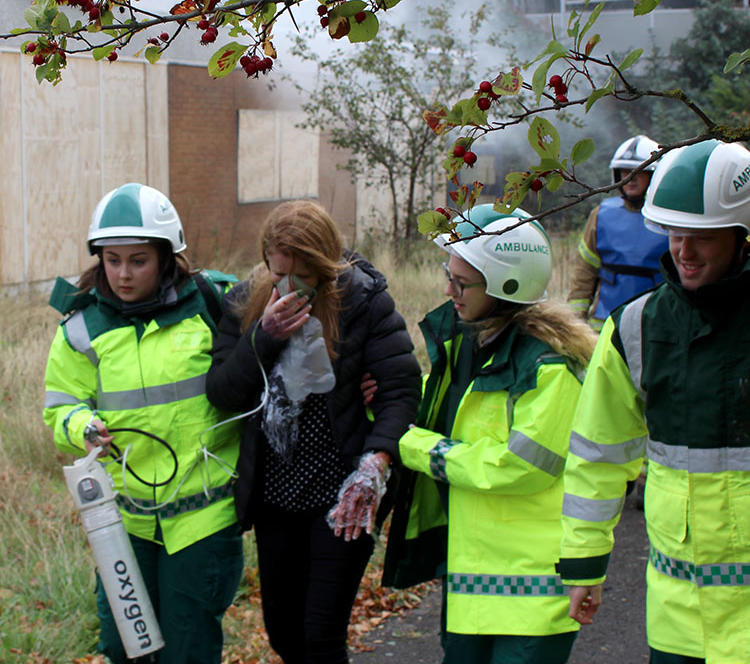
Alongside work-based learning you’ll be taught through a mix of lectures, interactive workshops and scenario-based learning through looking at case studies. There will also be opportunities to work alongside students training for different healthcare roles in our skills and simulation sessions, allowing you to gain experience and and in-depth understanding of how different healthcare teams work together.
Teaching and assessment contents
Theory:
Theory teaching is delivered through a structured programme informed by constructivist, experiential, and transformative learning principles, ensuring that students actively engage with content and apply knowledge in authentic contexts. Theory teaching is delivered in the following formats:
- Lead Lectures: Delivered both on-campus and synchronously online, lead lectures introduce foundational concepts to students. In core modules, lead lectures are delivered to all students and introduce nursing knowledge and ideas that are applicable across all fields of nursing practice. In field-of-practice modules, lead lectures focus on more specialist underpinning theoretical concepts for each field of nursing practice.
- Seminars: Delivered both on-campus and synchronously online, seminars are delivered in smaller field of practice/mixed field groups that enable students to contextualise theoretical content within their chosen field of nursing practice, or develop holistic skills to provide care to all individuals. Seminars use smaller group activities to engage in dialogue, debate, and reflection to encourage deeper understanding and critical thinking. Seminar-based learning is aligned with constructivist learning principles.
- Workshops: Interactive workshops which are delivered both on-campus and synchronously online. Workshops are delivered in field of practice/mixed field groups and use interactive, case-based and problem-based learning approaches, allowing students to apply theory to practice and develop clinical reasoning skills in a structured and interactive learning environment. Workshop activities facilitate learning grounded in experiential learning practices.
- Guided learning: Hybrid asynchronous-synchronous activities, delivered online and hosted via the specific module Blackboard Ultra pages. Guided learning tasks reinforce taught content and support the development of academic skills and insight into learning to learn. Guided learning activities are structured tasks that support heutagogical learning principles that encourage autonomy and lifelong learning. Guided learning activities are time-bound and tutor monitored, distinguishing them form self-directed and independent learning.
- Online directed asynchronous learning: Delivered through Blackboard Ultra, directed learning refers to activities delivered online, including discussion boards, quizzes, and reflective journaling.
- Independent learning: Independent self-study is designed to develop critical thinking and academic autonomy, support heutagogy, and prepare students for lifelong learning and professional development. It is supported by a range of excellent learning facilities, including the Hive and library resources, the virtual learning environment, and extensive electronic learning resources.
Practice:
Practice learning is central to the BSc (Hons) Nursing programme and is underpinned by experiential learning theory and social learning principles, ensuring students develop competence through authentic, real-world experiences. These approaches align with the NMC (2024) Standards of Proficiency for Registered Nurses and the NMC (2023) Part 2: Standards for Student Supervision and Assessment. Practice learning consists of simulated practice learning and undertaking practice placements in a diverse range of clinical settings across the programme. The real-world learning environments that clinical and simulated practice placements offer foster work-readiness, professional development, confidence, and competence.
In line with the NMC (2023) Part 3: Standards for Pre-registration Nursing Programmes, practice learning constitutes 50% of the total programme hours. Practice placements are delivered in blocks, enabling students to immerse themselves in practice environments and apply theoretical knowledge in real-life contexts, a key feature of experiential learning. Students will usually complete two distinct placements per part (year) of the programme primarily in their chosen field of Adult, Children’s or Mental Health nursing practice. To broaden exposure, students can also undertake ‘spoke’ experiences in alternative or non-traditional settings. These spoke experiences provide students with exposure to caring for people across the lifespan with physical, mental health, learning disabilities, and complex conditions, fostering awareness of the complexities of care, cultural responsiveness, and adaptability to diverse settings and needs.
Students are supernumerary while on practice placement. They are supported and supervised by their Practice Supervisors and assessed by Practice Assessors, who have undertaken additional training to undertake these roles in the practice learning environment. Students will also be assigned an Academic Assessor in line with the NMC (2023) Part 2: Standards for Student Supervision and Assessment for each part of their course, who will provide additional support during practice learning and ensure that the required standards are met to progress through the programme or complete it at the end of the final part. The relationships between student, Practice Assessor, Practice Supervisor and Academic Assessor reflect a coaching pedagogy that fosters the development of professional identity and confidence.
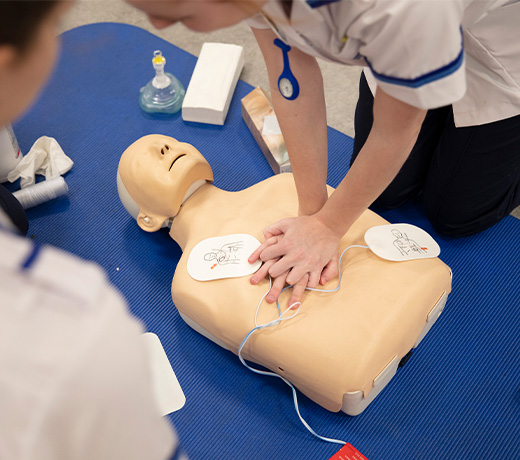
To complement real-world practice, students will complete 487.5 hours (max 600 hours) of simulated practice learning as part of the BSc (Hons) Nursing programme, which contribute to the total practice learning hours. Simulated practice learning activities, which are delivered both virtually and on-campus in high-fidelity simulation suites and community settings, mirror authentic clinical scenarios, and integrate technology to enhance learning, supporting digital literacy and aligning with NHS digital transformation priorities. Simulation incorporates role-play, manikins, and video-assisted reflections, embedding formative feedback from staff and peers throughout to promote continuous improvement and safe practice. Immersive simulations are realistic clinical scenarios where students gain experience with clinical procedures and skills in realistic settings, contextualising learning. The pedagogical approach to practice learning facilitates a transformative experience, developing autonomous and reflective practitioners capable of navigating complex care environments and contributing to service improvement. All simulated practice learning is supported and supervised by Practice Supervisors.
Students can also undertake UK or international elective placements during year 3, semester one. This may be a formative four-week experience or a summative placement of six to twelve weeks, both of which support awareness of global health perspectives and enhance employability. While undertaking electives, students are supernumerary and supported and assessed in line with the NMC (2023) Part 2: Standards for Student Supervision and Assessment.
Entry requirements
UCAS tariff points required: 112
We accept a range of qualifications, including Access to HE Diplomas and T-Levels. We also take into account any work or life experiences you have, alongside any qualifications you hold.
You’ll need to apply for this course through your employer, with their support. Individuals cannot apply directly to the University.
Any questions?
If you have any questions about entry requirements, please email apprenticeships@worc.ac.uk
Fees
Fees contents
Fees for this apprenticeship will be paid by the employer, through apprenticeship funding via the Growth and Skills Levy.
How to apply
How to apply contents
All applications must be made through your employer, and you must have their full support.
Please discuss your interest in the apprenticeship with your line manager
and/or HR department. Your employer can then contact the University to begin
the application process.
Individuals cannot apply directly to the University.
Contact
If you have any questions, please get in touch. We're here to help you every step of the way.
Apprenticeships team
apprenticeships@worc.ac.ukMore to explore
Open Days
Visiting us is the best way to get a feel for student life at the University of Worcester.

The City of Worcester
Worcester is a welcoming university city with great transport links and plenty of student parking.

Accommodation
Benefit from our accommodation guarantee. We have rooms on campus to suit every budget including en-suite options.