You’ll need to apply for this course through your employer, with their support. Individuals cannot apply directly to the University.
With this degree you’ll be eligible to register with the NMC as a Nursing Associate.
Overview
This apprenticeship offers a flexible, authentic practice-learning course where you will develop into a competent, confident and compassionate Nursing Associate, able to provide high quality, safe and responsive person-centred care across the lifespan in a diverse range of care settings.
With a blended mix of in-person and online activities, independent study, flipped classrooms and practical learning in both the skills and simulation centre and on placement, the course provides an inclusive environment where you’ll be able to learn in the way that best suits you.
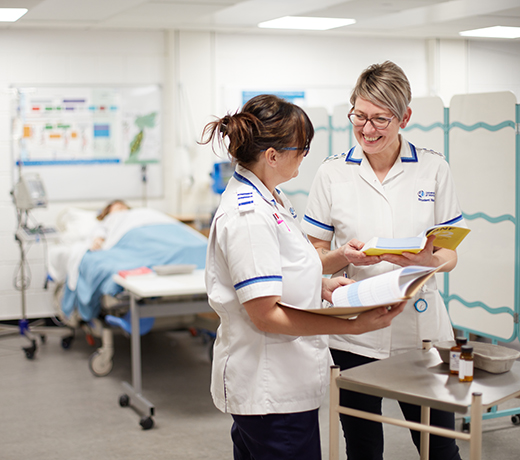
The apprenticeship is delivered at Worcester on our St John’s Campus and on the Severn Campus in the newly opened Duke’s building that includes contemporary skills and simulation facilities for Student Nursing Associates to safely practice in a supported and safe environment.
As a Student Nursing Associate, you will be promoting good health, monitoring care and being an accountable member of the team as you support registered nurses who coordinate and lead in nursing care. To prepare you for these responsibilities, you’ll learn the factors of health and wellbeing throughout the human lifespan, alongside the fundamentals of human anatomy, person centred care, evidence-based practice and team working.
The Nursing Associate Apprenticeship is delivered with support from your employing organisation allowing you to immediately embed your learning into practice in the workplace. You will also benefit from personalised support from lecturers and your assigned personal academic tutor who will work in close collaboration with you and your employer to support your development towards a Registered Nursing Associate with the Nursing and Midwifery Council (NMC).
How apprentices study
Teaching and learning on an apprenticeship will be a collaborative process between you, your employer and the university. This will include attending university for tutorials, work-based learning, when required to complete the apprenticeship an alternative placement and mentoring by a qualified/experienced colleague.
In a typical week apprentices have around 6 - 9 contact hours of university teaching across 3 semesters. However, the precise contact hours will depend on the year of study and the module you are studying. An example of teaching contact time will be structured around:
- 3 hours of interactive workshops/skills simulations or student seminars either face to face or online
- 3 hours of (large group) lectures either face to face or online
- 3 hours of asynchronous online teaching and learning
Apprenticeship students will have the opportunity to study alongside other students completing a BA (Hons) or BSc (Hons) Degrees.
As an apprentice, you’ll spend part of your working time developing the knowledge, skills and behaviours needed for your qualification. This is known as ‘off-the-job’ learning, and your employer will support you to complete it. You and your employer will agree how this learning is structured to best support your development and progress.
Nursing Associate Apprenticeship
Course content
On this accredited course, you’ll study the evidence behind the core theories and benefit from applying your learning in practical teaching sessions in our simulation centre and during your professional practice.
Our industry informed modules incorporate student and employer feedback, which mean they do occasionally change to ensure your learning stays up-to-date and relevant.
The modules are all compulsory to meet the requirements of the NMC (2018) pre-registration standards of proficiency for nursing associates.
We regularly review our courses to reflect the latest research and developments in the subject area, as well as feedback from students, employers and the wider sector. As a result, modules may change to ensure the course remains current and relevant.
Careers and employability
Once you successfully complete our apprenticeship, you’ll be eligible to apply for registration with the Nursing and Midwifery Council (NMC). This professional registration is essential for practice and confirms you meet national standards for safe and effective care.
Most graduate apprentices are offered roles within their work place as registered nursing associates.
As your career as a qualified Nursing Associate develops, you will be able to work in a range of roles within the NHS. Future careers could include:
- Clinical associates
- Care coordinators
- Clinical research associates
- Working with mental health services
Students who successfully complete the FdSc Nursing Associate may also be eligible to apply to our BSc Nursing (Adult) course at the midpoint (18 months) of the 3-year course, successful completion of which widens the career path to a vast range of registered nursing roles within the NHS and private sectors.
As a Nursing Associate student at the University of Worcester, you’ll have the chance to meet with local healthcare employers to discuss career opportunities and ways to further your professional development. You’ll have access to recruitment events and NHS Trust job advertisements via the teaching team and our Careers and Employability Service, who also provide support in CV writing and preparing for interviews.
Course highlights

Teaching and assessment
There is an increasing focus on patient-centred care and cultural competence in nursing associate practice. The revised programme from September 2026 will include modules that highlight communication skills, empathy, and cultural sensitivity to better prepare nursing associates for working with diverse populations.
The incorporation of human factors education into the curriculum will help nursing associate students to promote safer, more effective healthcare environments.
Promotion of compassion and resilience through dedicated modules and activities will ensure graduates are well-equipped to handle the emotional and psychological demands of the nursing associate profession.
Teaching and assessment contents
Theory
The course offers a blended approach to learning that combines traditional classroom interaction with online components.
You’ll be taught through a combination of campus-based and online lectures, workshops, group activities, real-life case studies and practical learning in the skills and simulation centre, centring your learning in real-life situations. Recorded lectures, flipped classrooms, guided reading, online discussions, and e-learning tools will help you learn at your own pace. Study-skills will also be embedded into the course to help you become independent and confident in your learning.
The aim of using technology-enhanced learning methods is to provide a flexible, inclusive, and engaging learning experience that caters to diverse learning styles and needs.
Practice learning
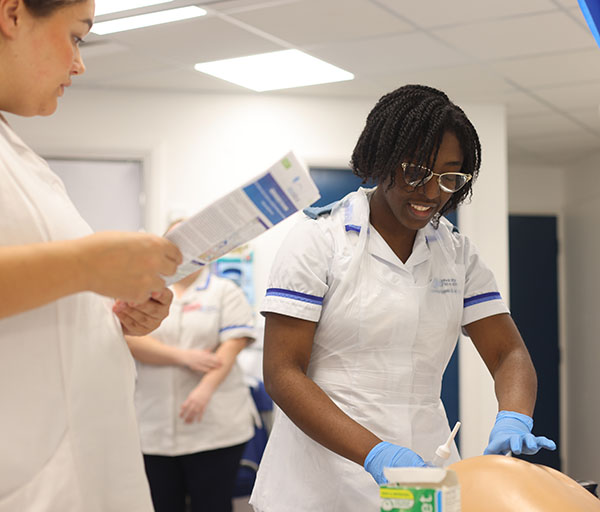
When working in the skills and simulation centre, you’ll have the opportunity to work with other students, service users/carers, practitioners, technicians and academics, alongside simulation manikins and videos to enhance your practical learning. You will also gain feedback on how you applied your learning in these simulated situations to assist the development of essential skills.
Skills and simulation offers an enhanced learning experience for students in a safe space within the theory modules, providing more diverse learning opportunities for comprehensive care across the lifespan.
You will undertake 2 summatively assessed practice placements per year aligned to the Standards for Student Supervision and Assessment (NMC 2023), providing opportunity for development of knowledge and skills through a wide range of learning experiences across the lifespan and a variety of healthcare settings.
As an apprentice, in addition to work-based learning, you`ll be offered placements in a variety of healthcare settings where you’ll gain experience in caring for people of various ages and health needs. Not only will these placements provide the chance to put what you’ve learnt into practice they will also enable you to broaden your scope of practice across diverse health settings across the lifespan. In addition you will have access to employer learning and development resources and have personalised practice support via your practice supervisor.
Support
Throughout the course you’ll be supported by your Personal Academic Tutor (a member of the Nursing Associate teaching team) who will ensure you are settling into the university, provide signposting information and academic support. They’ll help you reflect on your progress and support your development and achievement. You will be invited to meet with your tutor at least four times a year, but you can request a meeting at any point during your time on the course.
To integrate theory and practice and to development your knowledge, skills and behaviours all apprentices have 4 tripartite individual learner reviews each year. Members of this review will include the employer/assessor/supervisor, a university representative and the apprentice. Undertaking these scheduled tripartite meetings will allow individual monitoring of progress across the apprenticeship.
Entry requirements
We accept a range of qualifications, including Access to HE Diplomas. We also take into account any work or life experiences you have, alongside any qualifications you hold.
You’ll need to apply for this course through your employer, with their support. Individuals cannot apply directly to the University.
Any questions?
If you have any questions about entry requirements, please email apprenticeships@worc.ac.uk
Fees
Fees contents
Fees for this apprenticeship will be paid by the employer, through apprenticeship funding via the Growth and Skills Levy.
How to apply
How to apply contents
All applications are through your employer, and you must have the support of your employer. Please discuss the possibility of completing the apprenticeship with your line manager and/or HR department. Your employer can then contact the University to discuss applying to the programme.
Individuals cannot apply directly to the University.
Contact
If you have any questions, please get in touch. We're here to help you every step of the way.
Apprenticeships team
apprenticeships@worc.ac.ukMore to explore
Open Days
Visiting us is the best way to get a feel for student life at the University of Worcester.

The City of Worcester
Worcester is a welcoming university city with great transport links and plenty of student parking.

Accommodation
Benefit from our accommodation guarantee. We have rooms on campus to suit every budget including en-suite options.