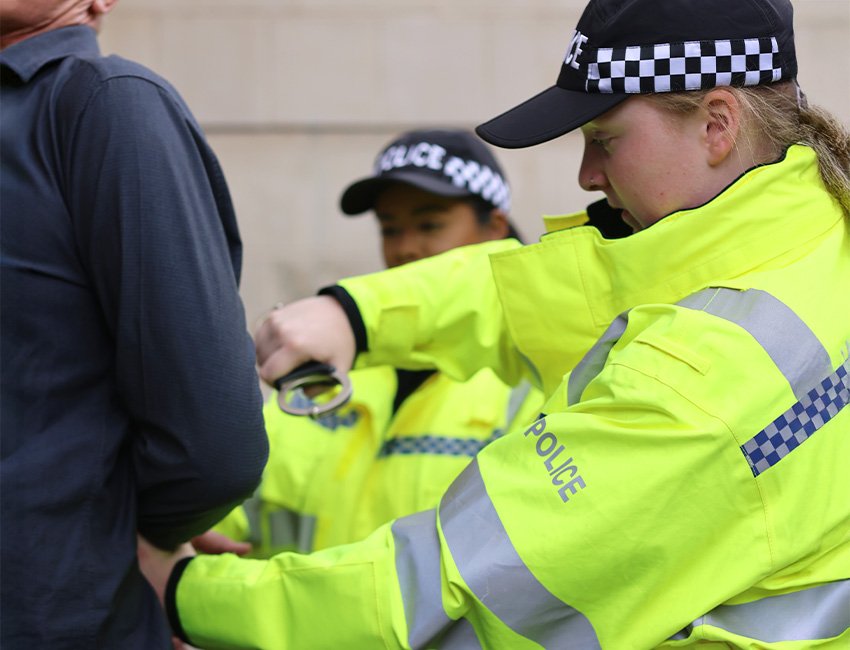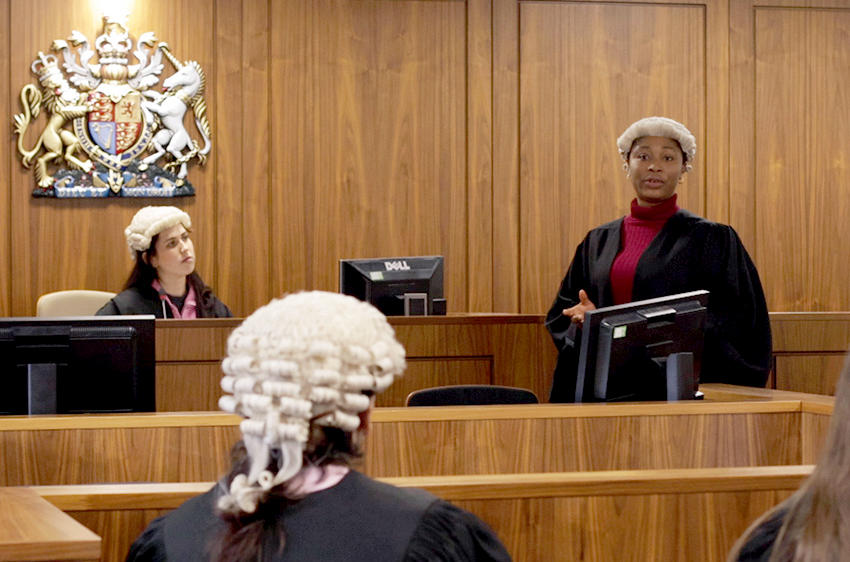
At Worcester, you’ll join a friendly law community just minutes from the city courts, with access to our mock courtroom, pro bono work, political links and real opportunities to make a difference in the community.
of students are in work and/or study 15 months after graduating
of students were positive about the teaching on the course
Overview
By studying Law with Politics, you’ll explore how laws are made, how governments work and how political decisions shape people’s everyday lives. The course builds a strong foundation in key areas of law, such as Contract, Public, Criminal and EU law, alongside Westminster, European and global politics. Together, these subjects give you a wider understanding of who holds power, how decisions are made and how legal and political systems influence each other.
You’ll be involved in active discussions and debates from day one. Teaching regularly involves debating how Parliament responds to national issues, analysing recent political events or working through how criminal or contractual disputes are decided. Case studies, group discussions and real examples help you make sense of both law and politics in practice. As you progress, you can focus on the areas that interest you most, whether that’s employment rights, medical ethics, family law, or global political challenges.
If you’re considering a future as a solicitor or barrister, the LLB will provide you with a solid grounding for your future preparation for Stage 1 of the Solicitors Qualification Examination (which is required by the Solicitors Regulation Authority) and further studies on the Bar Professional Training Course (as required by the Bar Standards Board).
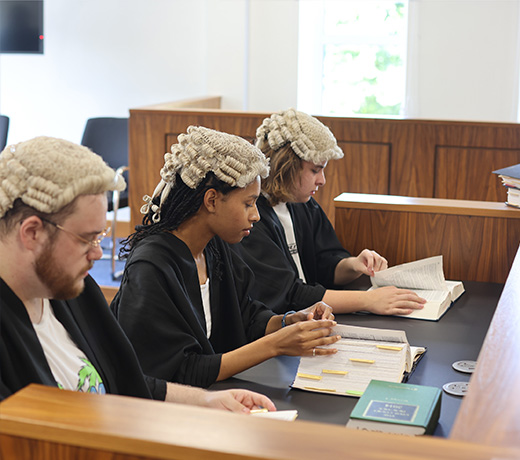
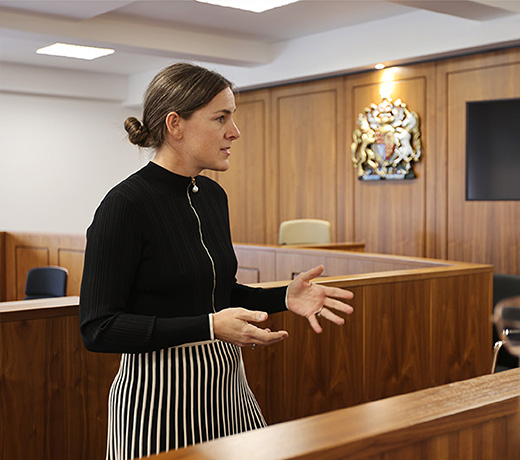
Working in our purpose-built courtroom will help you feel at ease in professional legal settings. You’ll work on moots, mock trials and client interviewing practices, learning to think and act like a lawyer by practicing advocacy and negotiation.
Whether you’re aiming for a legal career or aspire to work in policy, public service, campaigning or community roles, you’ll graduate with valuable experience, a strong mix of skills, and deeper understanding of the legal and political forces driving change in the world.
Placements
Pro bono activity is a significant part of our extra-curricular offerings, including through our Legal Advice Clinic, giving you the chance to work alongside practising solicitors and develop your legal skills while making a genuinely positive contribution to society.
You can also choose to complete an optional work-based placement in your third year, at an approved legal organisation such as a solicitor’s firm, a barrister’s chambers, or local government. These experiences are valuable even if you're interested in policy, public service or campaigning, as they expose you to the real issues people face, the impact of legal decisions on communities, and the way law and politics interact in practice.
Whatever your career goals, placement opportunities help you build confidence, understand professional environments and develop the people‑focused skills that employers look for.
Discover Law at Worcester
Course content
Each year you’ll study a mix of law and politics topics that build your knowledge step by step. Mandatory modules give you a strong grounding in core legal areas, while optional modules in your third year let you tailor your studies towards subjects that interest you most.
We regularly review our courses to reflect the latest research and developments in the subject area, as well as feedback from students, employers and the wider sector. As a result, modules may change to ensure the course remains current and relevant.
Optional modules will run if enough students choose to study them. It is not guaranteed that all modules will be offered every year.
Careers
An LLB in Law with Politics opens doors to a wide range of careers. Many students study this course because they want to make a difference, but aren’t yet sure which area they’d like to specialise in. Throughout your degree, you’ll explore a wide range of topics such as family law, employment rights, and EU policies, helping you discover the direction that feels right for you.
Work experience is built into the course. Pro bono opportunities and activities in our Legal Advice Clinic allow you to support real clients alongside practising solicitors. You can also choose an optional work-based placement in your third year, working in settings such as a solicitor’s firm, a barrister’s chambers, a political office, or campaign team, or within our own Legal Advice Clinic. These experiences help you understand how legal and political decisions affect people’s lives and give you valuable, people-focused skills.
You’ll be supported by the Law School’s dedicated employability team who run regular drop-ins for CV support, applications and interview practice. Mooting, mock trials and advocacy work all help you build confidence and communication skills that are useful in every career.
This course could be your first step towards becoming a:
- Solicitor
- Barrister
- Policy Officer
- Legal Executive
- Researcher for an MP or councillor
- Paralegal
- Political Adviser
- Compliance Officer
- Civil Servant
- Public Affairs Consultant
Opportunities to progress
Opportunities to progress on to a postgraduate qualification at Worcester include our Legal Practice LLM and Law MPhil/PhD.
Course highlights




Teaching and assessment
Teaching is a mix of interactive lectures, seminars, workshops and practical courtroom activities. You’ll learn through debates, case studies and small‑group discussions that help you apply your knowledge to real situations.
This course has been designed to prepare you for professional practice, so evaluation is not all about written assignments and exams. You’ll also be assessed on your knowledge through oral presentations, research projects and moot activities.
Teaching and assessment contents
You are taught through a combination of interactive lectures, seminars, workshops and practical courtroom exercises. Interactive lecture sessions take a variety of formats and are intended to enable the application of learning through discussion and small group activities. Seminars enable the discussion and development of understanding of topics covered in lectures, and wider activities – such as those within the mock courtroom – are focused on developing subject-specific skills and graduate skills.
In addition, meetings with Personal Academic Tutors are scheduled on at least four occasions in the first year and three occasions in each of the other years of a course.
The University places emphasis on enabling students to develop the independent learning capabilities that will equip them for lifelong learning and future employment, as well as academic achievement. A mixture of independent study, teaching and academic support from Student Services and Library Services, and also the Personal Academic Tutoring system enables students to reflect on progress and build up a profile of skills, achievements and experiences that will help them to flourish and be successful.
Meet the team
A small selection of the Humanities lecturers who teach on this course.
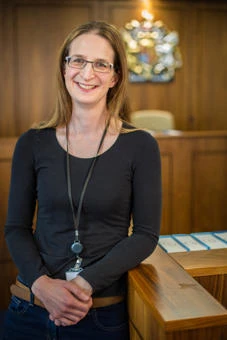
Nicola Monaghan
Nicola Monaghan is a Principal Lecturer at the University of Worcester. She has taught at the University of Worcester since the School of Law opened in 2016. She has been teaching law at Higher Education institutions since 2001 and specialises in Criminal Law, Criminal Procedure and the Law of Evidence.
Nicola’s research interests include jury misconduct and the criminal trial and she has published a wide range of journal articles in the Journal of Criminal Law, International Journal of Evidence and Proof, and Information and Communications Technology Law. Her work has been cited widely by academics and by the Law Commission.

Dr Luke Devine
Luke's teaching specialisms include sociology of religion, political philosophy, antisemitism, Freud and psychoanalytic sociology, and Jewish history and literature.
His research is primarily focused on fin de siècle Anglo-Jewish literature, particularly Amy Levy, on representations of Shekhinah in Jewish mystical literature, and on Sociology of Religion.

Dr Chris Monaghan
Dr Chris Monaghan is a Principal Lecturer in Law and the Director of the University of Worcester’s Constitutions, Rights and Justice Research Group. He has taught at the University of Worcester since the School of Law opened in 2016. He has published in journals such as the Criminal Law Review, Judicial Review, European Human Rights Law Review, Public Law, and Legal Studies.
Chris enjoys researching Constitutional Law, the role of Parliament (with an emphasis on accountability), broader notions of executive accountability, and the global use of impeachment. He also researches on the Chagos Islands. Alongside law, he has a keen interest in constitutional and political history.
Nicola Monaghan
Nicola Monaghan is a Principal Lecturer at the University of Worcester. She has taught at the University of Worcester since the School of Law opened in 2016. She has been teaching law at Higher Education institutions since 2001 and specialises in Criminal Law, Criminal Procedure and the Law of Evidence.
Nicola’s research interests include jury misconduct and the criminal trial and she has published a wide range of journal articles in the Journal of Criminal Law, International Journal of Evidence and Proof, and Information and Communications Technology Law. Her work has been cited widely by academics and by the Law Commission.
Dr Luke Devine
Luke's teaching specialisms include sociology of religion, political philosophy, antisemitism, Freud and psychoanalytic sociology, and Jewish history and literature.
His research is primarily focused on fin de siècle Anglo-Jewish literature, particularly Amy Levy, on representations of Shekhinah in Jewish mystical literature, and on Sociology of Religion.
Entry requirements
UCAS tariff points required: 120
| Qualification | Grade |
|---|---|
| A-level | BBB |
| BTEC National Extended Diploma | DDM |
| T-level | Merit |
We do accept Access to HE Diplomas and other qualifications which may not exactly match the combinations above. Work out your estimated points with the UCAS tariff calculator.
Any questions?
If you have any questions about entry requirements, please call our Admissions Office on 01905 855111 or email admissions@worc.ac.uk.
Fees
Fees contents
UK and EU students
The standard fee for full-time home and EU undergraduate students on BA/BSc/LLB degrees and FdA/FdSc degrees in the academic year 2027/28 is £10,050 per year.
Tuition fees are reviewed annually and may increase each year for both new and continuing students.
For more details on course fees, please visit our course fees page.
International students
The standard tuition fee for full-time international students enrolling on BA/BSc/LLB degrees and FdA/FdSc degrees in the academic year 2027/28 is £17,700 per year.
Tuition fees are reviewed annually and may increase each year for both new and continuing students.
For more details on course fees, please visit our course fees page.
How to apply
How to apply contents
Applying through UCAS
UCAS is the central organisation through which applications are processed for full-time undergraduate courses in the UK.
Read our how to apply pages for more information on the application process, or if you’d like to apply for part-time study.
Law with Politics: ML22
Contact
If you have any questions, please get in touch. We're here to help you every step of the way.

Admissions Office
admissions@worc.ac.uk01905 855111More to explore
Open Days
Visiting us is the best way to get a feel for student life at the University of Worcester.
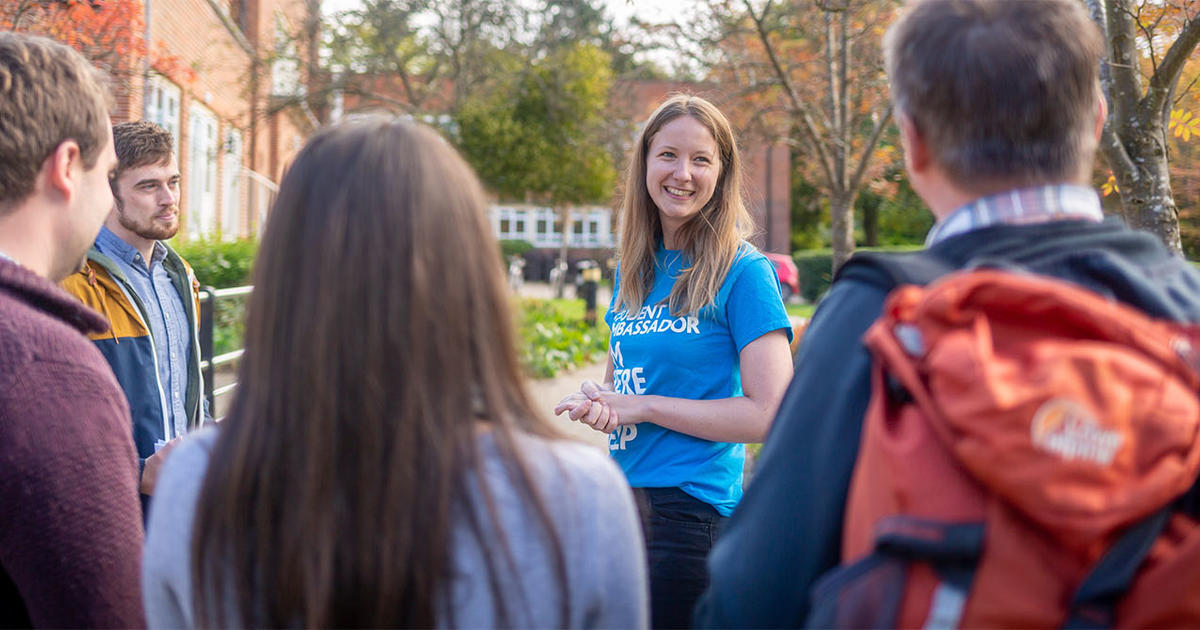
The City of Worcester
Worcester is a welcoming university city with great transport links and plenty of student parking.

Accommodation
Benefit from our accommodation guarantee. We have rooms on campus to suit every budget including en-suite options.