You’ll need to apply for this course through your employer, with their support. Individuals cannot apply directly to the University.
Overview
If you’re already working in maternity or healthcare and want to become a qualified midwife, this Midwifery Degree Apprenticeship helps you take that next step while staying in paid employment. You’ll train to support women, birthing people, babies and families through pregnancy, birth and the postnatal period, combining university study with real responsibility in practice.
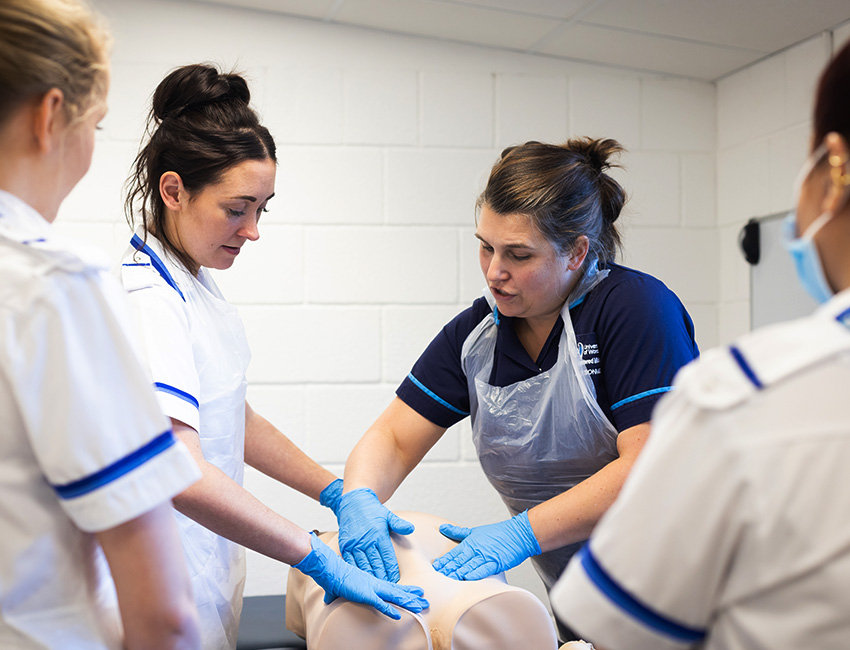
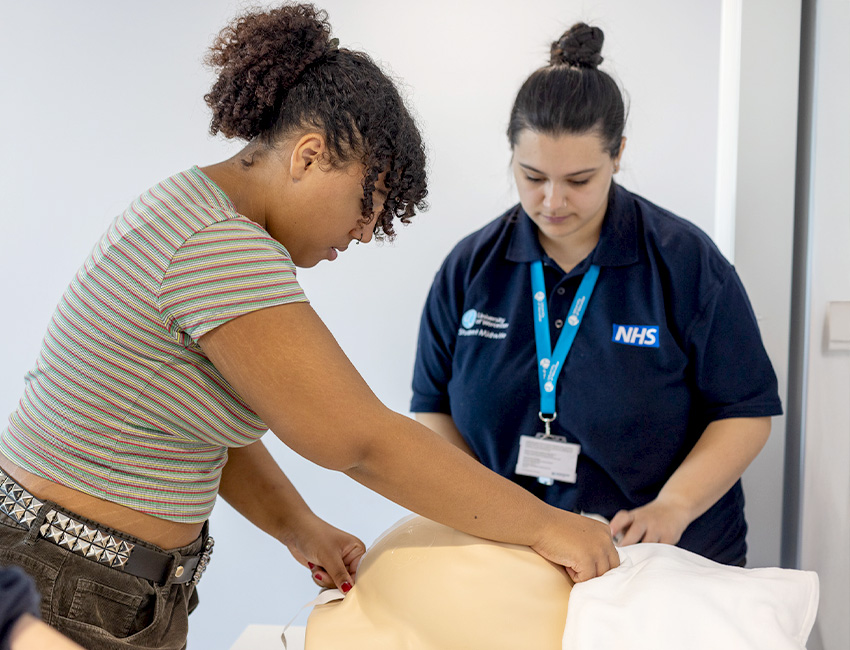
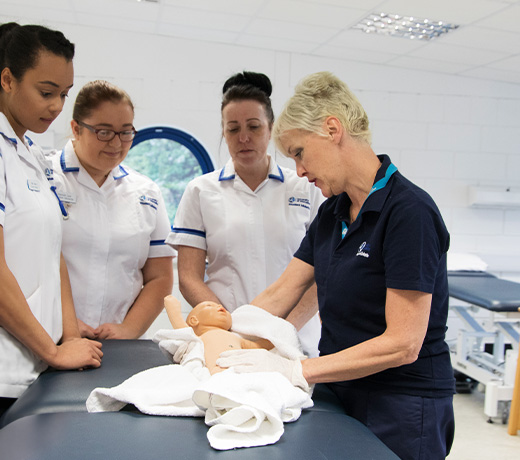
You’ll build your confidence step by step. On campus, you’ll develop your skills in our Midwifery Skills and Simulation Centre, practising everything from newborn assessment to supporting labour and recognising emergencies in a safe, realistic setting. In teaching sessions, you’ll explore topics such as normal and complex pregnancy, perinatal mental health, infant feeding, safeguarding and public health, linking what you learn to real clinical scenarios.
Your workplace will be a key learning environment, supported by additional placements in hospital and community maternity services. You’ll work alongside experienced midwives, learn how to prioritise care, work safely in a team, and provide compassionate, person-centred support to diverse families.
Throughout the apprenticeship, you’ll be supported by lecturers and practice educators who get to know you, understand your strengths and help you to grow into a confident, capable midwife. The degree apprenticeship meets Nursing and Midwifery Council standards, so you’ll be ready to apply for registration as a midwife when you successfully complete your studies.
How apprentices study
Teaching and learning on an apprenticeship will be a collaborative process between you, your employer and the university. This will include attending university for tutorials, work-based learning, when required to complete the apprenticeship an alternative placement and mentoring by a qualified/experienced colleague.
In a typical week apprentices have around 6 - 9 contact hours of university teaching across 3 semesters. However, the precise contact hours will depend on the year of study and the module you are studying. An example of teaching contact time will be structured around:
- 3 hours of interactive workshops/skills simulations or student seminars either face to face or online
- 3 hours of (large group) lectures either face to face or online
- 3 hours of asynchronous online teaching and learning
Apprenticeship students will have the opportunity to study alongside other students completing a BA (Hons) or BSc (Hons) Degrees.
As an apprentice, you’ll spend part of your working time developing the knowledge, skills and behaviours needed for your qualification. This is known as ‘off-the-job’ learning, and your employer will support you to complete it. You and your employer will agree how this learning is structured to best support your development and progress.
Course content
On this accredited course you’ll study theories backed up by substantial evidence, and then get the opportunity to apply this learning in professional practice.
We regularly review our courses to reflect the latest research and developments in the subject area, as well as feedback from students, employers and the wider sector. As a result, modules may change to ensure the course remains current and relevant.
All modules are mandatory to ensure you’re eligible to register as a midwife with the NMC.
Careers and employability
Most graduate apprentices are offered roles within their workplace as Registered Midwives. This qualification prepares you to register with the Nursing and Midwifery Council and continue your career supporting women, birthing people, babies and families in maternity services.
You’ll build the clinical experience needed to work safely and compassionately in a range of settings, including hospital maternity unites, midwife-led units, and community services. Your practice learning, workplace experience, and additional placements will help you understand the full breadth of midwifery – from antenatal care and labour support to postnatal assessment and early parenting.
As your career develops, you may progress into roles such as:
- Senior midwife
- Specialist midwife (for example perinatal mental health, infant feeding, diabetes, or safeguarding)
- Community midwife
- Continuity of carer midwife
- Practice educator
- Ward or birth centre manager
Your apprenticeship gives you a strong foundation for long‑term professional development. You’ll be supported by the academic team with career planning, preparing personal statements, and practising interview skills, helping you move confidently into the next stage of your midwifery career.
Course highlights
Teaching and assessment
Teaching is a mix of interactive seminars, lectures, one-to-one tutorials, and practical skills sessions. Your assessments will help prepare you for a career as a midwife, and include observations of professional skills, writing reflective essays, presenting, group discussions and creating care plans.
Teaching and assessment contents
Theory
You are taught through a blended learning approach combining face-to-face, on campus teaching and clinical practice with online and digital learning activities. Learning may occur through both real-time activities, such as live lectures, skills and simulation sessions, tutorials, and discussions, and self-paced activities, such as recorded lectures, online reading, and reflective tasks. This blended approach promotes flexibility, self-directed learning, and active engagement, supporting your achievement of the Standards of proficiency for midwives (NMC 2019) and the development of the knowledge, skills, and professional behaviours essential for safe and effective midwifery practice. There will be input from other agencies, service users and professionals as appropriate.
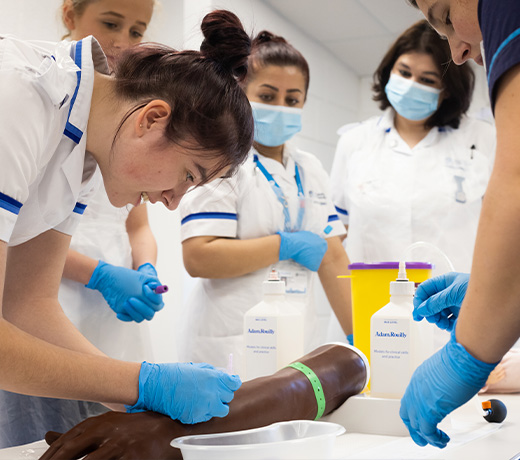
A particular feature of the programme is the opportunities for clinical and simulated learning including scenario-based activities, tutorials, narratives and technology enhanced learning opportunities including interactive virtual learning environments; digital medicines calculations resources, and clinical skills environments where a range of approaches are taken e.g. simulated patients, anatomy and physiology laboratory. Formative feedback on performance is provided to facilitate safe and effective support for essential skills development, in the simulation suites, replicating hospital, home and community practice learning environments
Practice Learning
Your practice learning experiences can range from hospitals and community settings, including exposure to Gynaecology, reproductive health and the life course. All students complete a medical/surgical placement and work in different settings including neonatal intensive care units.
You will complete a minimum of 2300 hours of clinical experience over the three years. Travel time for placements could be up to 90 minutes.
You will also spend time in an alternative maternity setting (NHS Trust). This is to experience different styles of leadership, ways of working and the culture of another NHS Trust, to support your own development as a leader and as part of a team.
You will work a 37-hour week, experiencing the range of hours expected of Registered Midwives and this will include evenings, nights, weekends and bank holidays.
You will have opportunity to complete a UK or international elective at the start of year 3.
Entry requirements
UCAS tariff points required: 120
We accept a range of qualifications, including Access to HE Diplomas and T-Levels. We also take into account any work or life experiences you have, alongside any qualifications you hold.
You’ll need to apply for this course through your employer, with their support. Individuals cannot apply directly to the University.
Any questions?
If you have any questions about entry requirements, please email apprenticeships@worc.ac.uk
Fees
Fees contents
Fees for this apprenticeship will be paid by the employer, through apprenticeship funding via the Growth and Skills Levy.
How to apply
How to apply contents
All applications must be made through your employer, and you must have their full support.
Please discuss your interest in the apprenticeship with your line manager and/or HR department. Your employer can then contact the University to begin the application process.
Individuals cannot apply directly to the University.
Contact
If you have any questions, please get in touch. We're here to help you every step of the way.
Apprenticeships team
apprenticeships@worc.ac.ukMore to explore
Open Days
Visiting us is the best way to get a feel for student life at the University of Worcester.

The City of Worcester
Worcester is a welcoming university city with great transport links and plenty of student parking.

Accommodation
Benefit from our accommodation guarantee. We have rooms on campus to suit every budget including en-suite options.