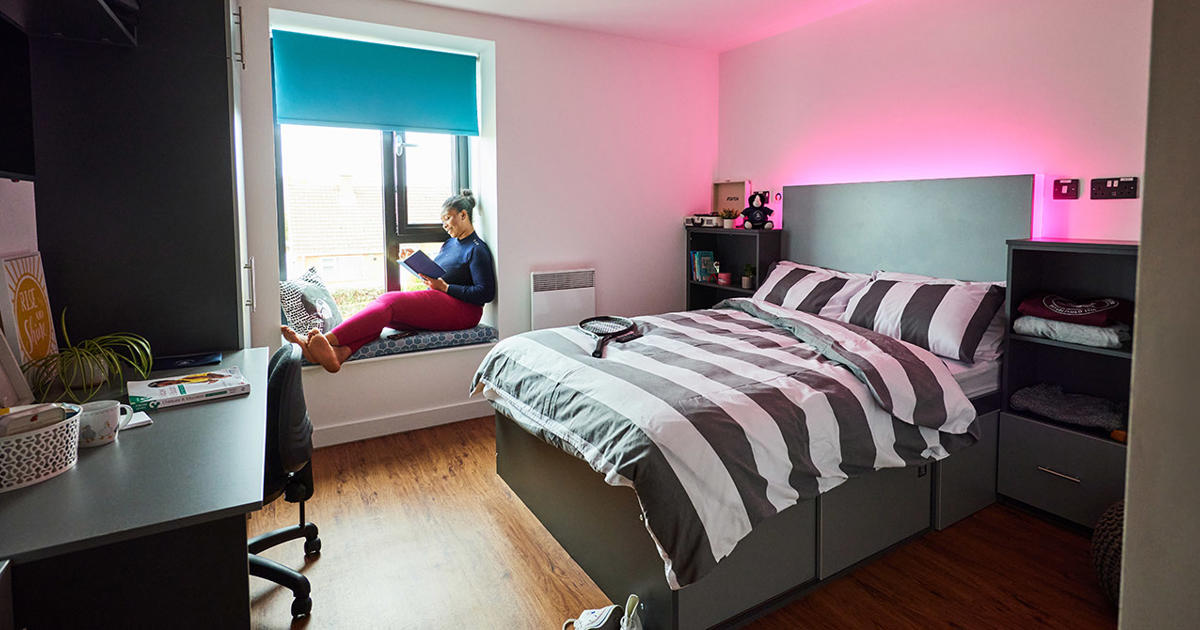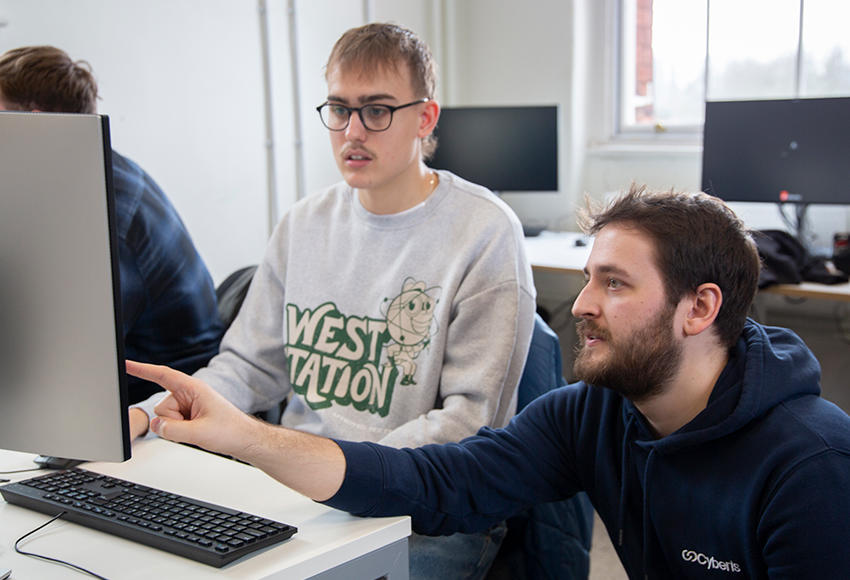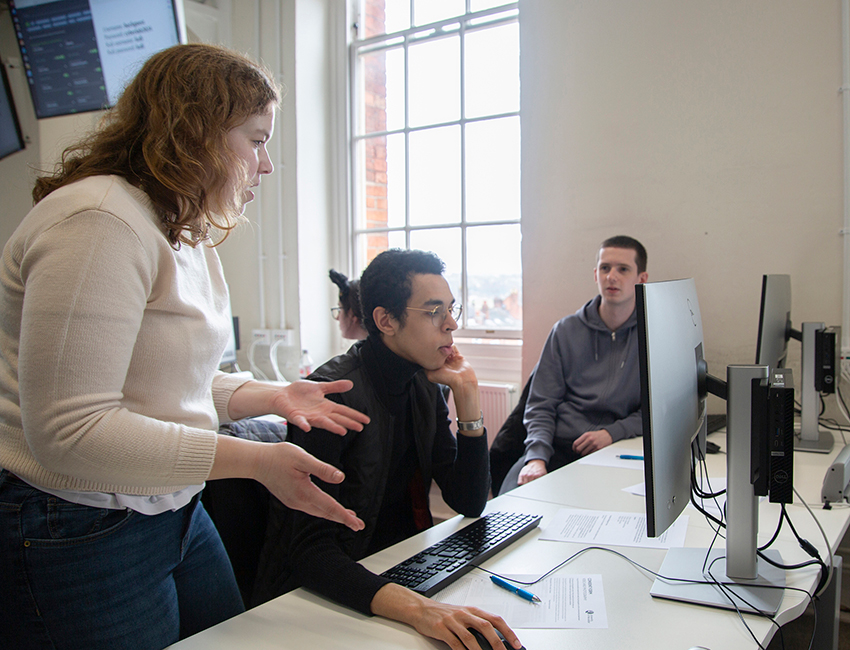
At Worcester you can choose modules to suit your interests and future career. Anything from web design, programming and information systems to cyber security and games development.
for student experience
for teaching quality
Professional associations
Our course and modules have been mapped to take advantage of curriculum recommendations and aims developed by the:
- British Computing Society (BCS)
- Institute of Electrical and Electronics Engineers (IEEE)
- Association of Computing Machinery (ACM)
Overview
In your first year you’ll learn the fundamentals of computer science, programming, and IT systems. You’ll then build on these foundations with a range of specialist optional modules in your second and third years.
Paid placements, work experience programmes and live client briefs will give you plenty of opportunities to develop practical skills. So that by the end of your degree you’ll be ready to present your final year project to industry representatives at our annual Computing Showcase.
At Worcester Business School you’ll join a community of students from all over the world, all based together on the same campus in the centre of Worcester. You’ll learn your classmates as well as guest lecturers and our expert academic team.
In your first few weeks at university, you’ll meet your friendly personal academic tutor and they typically remain with you throughout your degree. They’ll get to know your strengths and where you can develop, offering personalised support and feedback throughout the course.
Placements
On this course there are different ways to gain valuable work experience. You’ll have the opportunity to do a short, paid placement, a year-long internship or part-time work with a local business.
Our dedicated placement team offer one-to-one support - helping you find internships, make your application, and prepare for interview. You could choose to do your placement in the local area, making the most of connections with employers in the region, or you could choose to move another city or country.
Recent students have done placements and internships at Bosch, IBM, Clearview, and Electronic Arts.
Part-time work experience
You can earn money and get experience relevant to your degree with our Springboard Programme. Our placement team will match you with local businesses and regional employers.
Roles are typically short-term, and project based, but many of our students end up securing part-time contracts for the duration of their degree.
Course content
Each year you will study a mix of mandatory and optional modules. This flexible course lets you explore different subjects and career paths in computing before choosing to specialise in your final year.
We regularly review our courses to reflect the latest research and developments in the subject area, as well as feedback from students, employers and the wider sector. As a result, modules may change to ensure the course remains current and relevant.
Optional modules will run if enough students choose to study them. It is not guaranteed that all modules will be offered every year.
Careers
This degree could be the first step toward your career as an:
- App developer
- Forensic computer analyst
- IT project manager
- Cyber security officer
- Digital product owner
- Information scientist
- Solutions architect
- Systems analyst
- Web or UX designer
- Network engineer
Start your own business
If your goal is to be your own boss, our entrepreneurship modules will guide you through the process of planning and setting up your own business. You’ll also have access to start-up support and our network of business mentors.
Other options
You could choose to progress onto a postgraduate degree to take your learning even further. For example our Computing MSc or Artificial Intelligence MSc.
You could also train to teach with a one-year Primary or Secondary PGCE at Worcester.
Discover our cyber security lab
Course highlights

Teaching and assessment
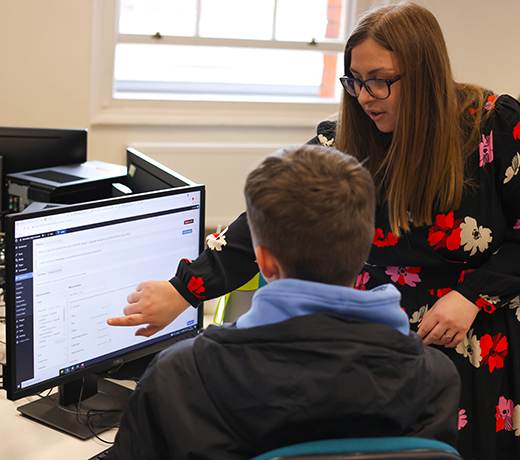
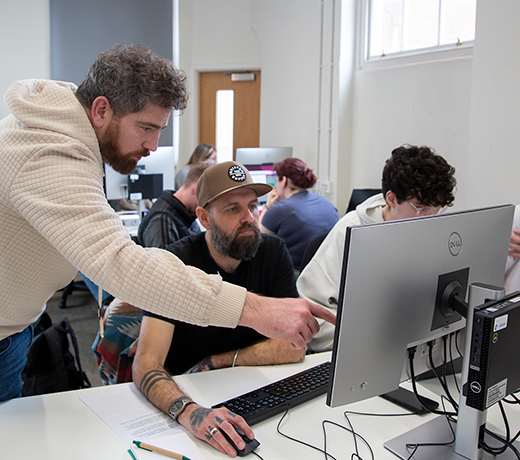
Our course has been designed by academics and industry specialists to prepare you for a career in computing. You’ll be taught through a combination of practical activities, seminars, lectures, and one-to-one tutoring.
Evaluation isn’t just about exams. Our applied assessment methods include practical projects, reports, portfolios, presentations, essays and a final year research or consultancy project - preparing you for the work you’ll be doing when you graduate.
Teaching and assessment contents
You are taught through a combination of interactive lectures, seminars and individual/ small group project work with a strong emphasis on real-world scenarios and practical applications. Most of the computing seminars take place in state-of-the-art PC labs using a variety of software specific to each module. The course integrates theory and practice in several areas of computing in order to obtain an appreciation of a range of applications and their impact on users.
In addition, meetings with personal academic tutors will take place several times a semester during your time at university.
You have an opportunity to undertake a year-long placement with local or national firms in the third year of the course, supervised by a work-based mentor and a University tutor.
You can also choose to study abroad in semester 2 of year 2 at one of our exchange partner universities in Australia, New Zealand, the United States, Canada and Europe.
Meet the team
Here are a few of the Business School staff members who teach on this course.

Richard Wilkinson
Richard is a Senior Lecturer in Computing, as well as the Head of the Department of Computing, teaching on a variety of modules for both Computing, Business IT and Business degrees. Here at the University of Worcester Richard leads on our Global Partnerships with QLIK, IBM Watson Analytics & Microsoft Dynamics.
Richard is published in the field of IT in Higher Education, is a Senior Fellow of the HEA, a member of the British Computer Society (BCS) and an External Examiner.
Chris Blythe
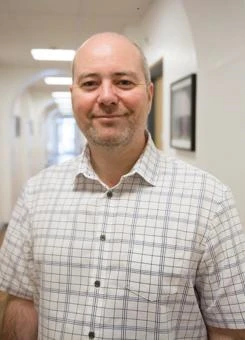
After a varied career Chris completed a Bachelors in Computing at the University of Worcester, then studied at the University of Helsinki followed by working at the University of Huddersfield as a researcher on Augmented Reality for Dementia. Chris is currently the Course Leader for the Computing undergraduate degrees, and teaches on modules in programming, web development, games design & development, and mobile development. His interests include Game Based Learning, Education for Sustainable Development and Augmented Reality for Dementia.

Akinola Olumide Siyanbola
Akinola is a Lecturer in Web Application Development with the Computing department at Worcester Business School. He has previously worked as a Senior Web developer before venturing into academics and Cyber security.
Akinola completed a BSc in Computer Science at Lagos State University, Nigeria, and proceeded to undertake his MSc in Cyber Security at Birmingham City University. Then, he secured a fully funded PhD research program with Birmingham City University, which is nearing completion soon. In addition, he completed a PGCert in research practice and a SEDA course in “Preparing postgraduates to teach in Higher Education”.
His research focuses on applying an intelligent and sematic-based methodology to cyber security application domains.
Richard Wilkinson
Richard is a Senior Lecturer in Computing, as well as the Head of the Department of Computing, teaching on a variety of modules for both Computing, Business IT and Business degrees. Here at the University of Worcester Richard leads on our Global Partnerships with QLIK, IBM Watson Analytics & Microsoft Dynamics.
Richard is published in the field of IT in Higher Education, is a Senior Fellow of the HEA, a member of the British Computer Society (BCS) and an External Examiner.
Chris Blythe
After a varied career Chris completed a Bachelors in Computing at the University of Worcester, then studied at the University of Helsinki followed by working at the University of Huddersfield as a researcher on Augmented Reality for Dementia. Chris is currently the Course Leader for the Computing undergraduate degrees, and teaches on modules in programming, web development, games design & development, and mobile development. His interests include Game Based Learning, Education for Sustainable Development and Augmented Reality for Dementia.
Entry requirements
UCAS tariff points required: 96
| Qualification | Grade |
|---|---|
| A-level | CCC |
| BTEC National Extended Diploma | MMM |
| T-level | Pass (C or above) |
We do accept Access to HE Diplomas and other qualifications which may not exactly match the combinations above. Work out your estimated points with the UCAS tariff calculator.
Any questions?
If you have any questions about entry requirements, please call our Admissions Office on 01905 855111 or email admissions@worc.ac.uk.
Fees
Fees contents
UK and EU students
The standard fee for full-time home and EU undergraduate students on BA/BSc/LLB degrees and FdA/FdSc degrees in the academic year 2027/28 is £10,050 per year.
Tuition fees are reviewed annually and may increase each year for both new and continuing students.
For more details on course fees, please visit our course fees page.
International students
The standard tuition fee for full-time international students enrolling on BA/BSc/LLB degrees and FdA/FdSc degrees in the academic year 2027/28 is £17,700 per year.
Tuition fees are reviewed annually and may increase each year for both new and continuing students.
For more details on course fees, please visit our course fees page.
How to apply
How to apply contents
Applying through UCAS
UCAS is the central organisation through which applications are processed for full-time undergraduate courses in the UK.
Read our how to apply pages for more information on the application process, or if you’d like to apply for part-time study.
Contact
If you have any questions, please get in touch. We're here to help you every step of the way.
Admissions Office
admissions@worc.ac.uk01905 855111More to explore
Open Days
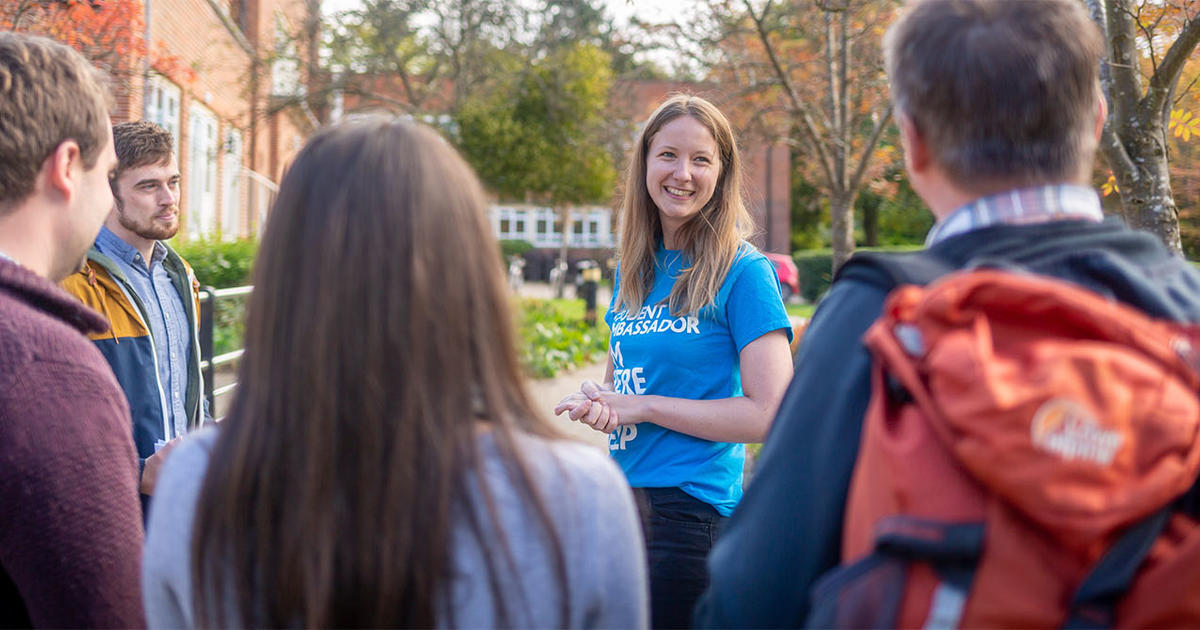
Visiting us is the best way to get a feel for student life at the University of Worcester.
The City of Worcester
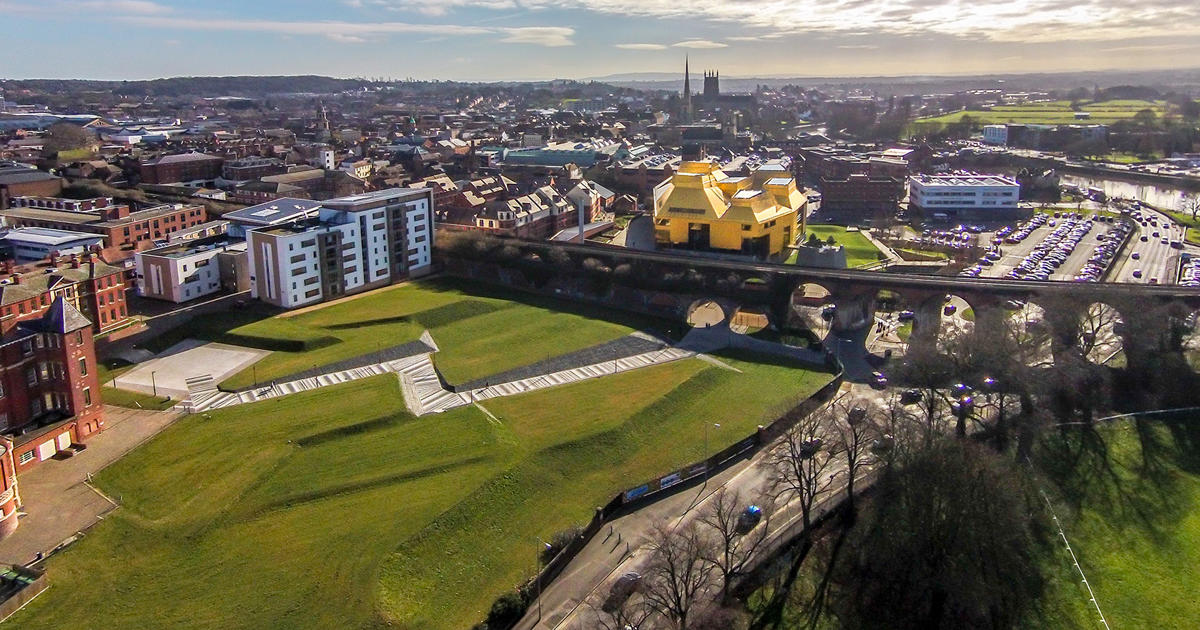
Worcester is a welcoming university city with great transport links and plenty of student parking.
Accommodation
Benefit from our accommodation guarantee. We have rooms on campus to suit every budget including en-suite options.